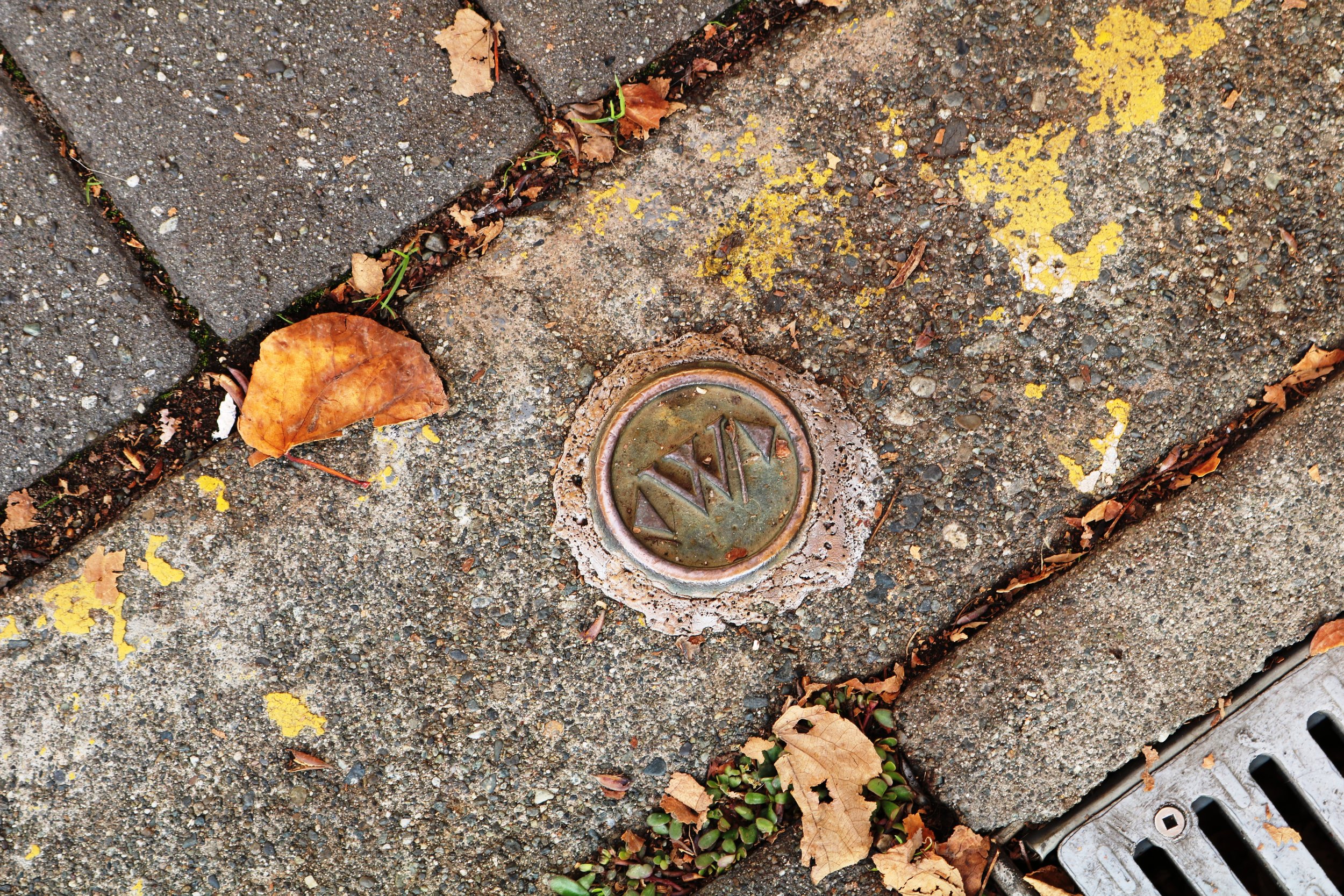
Sidney, British Columbia, Canada
A sewer cover sits in the pavement outside my childhood home on Amelia Avenue in Sidney, British Columbia. I didn’t know then that I would one day photograph these things, only that it marked a point of return — the place the street always resolved.
A few blocks away, set into Beacon Avenue, a compass in metal points toward Sidney Wharf and what we called “China Beach.” As children we followed that direction as if it were a promise.
China Beach was where the tide gave things back changed.
As children we searched the shoreline for sea glass — shards of bottles and discarded objects rolled for years in salt and motion until their edges softened, their surfaces clouded, their colours deepened. Garbage, remade by time and water into something you held up to the light.
Transformation through submersion.
Refinement through pressure and repetition.
Purification without spectacle.
If Cloacina presides anywhere, she presides in processes like this — not only in the engineered systems beneath cities, but in any unseen current that takes what is cast off and returns it altered, bearable, sometimes even luminous.
The whole coastline of Vancouver Island is beautiful. I know that now in the way adults know landscape — as geography, as memory, as distance. But that particular beach held awe in its original form for me: a place where nothing was wasted, where the hidden work of the ocean was visible in your palm.
A sewer cover.
And still “looking down” - A compass set into the street.
A shoreline of transformed glass.
All of them markers of the same idea: that what carries, what cleans, what reshapes, does its most important work out of sight — and leaves only small, durable signs at the surface.