The Unseen Work Framework™
The Cloacina Collective develops original thinking on the structural labour that makes seen performance possible.
Every enduring institution depends on work that protects coherence before instability becomes seen. This work regulates strain, preserves trust, anticipates risk and sustains ethical direction across time. Because it is preventative, it leaves little trace. It is absorbed by individuals and attributed to strength or temperament rather than recognised as infrastructure.
When this labour remains unseen, continuity depends on personal endurance. When it is named and designed for, prevention becomes structural capacity.
The Unseen Work Framework™ makes this stabilising labour explicit and provides a disciplined way of assessing where responsibility is concentrated, where risk is accumulating and where institutional endurance is either being secured or quietly undermined.
What Is Unseen Work?
Unseen work is the labour that protects coherence before instability becomes seen.
· It absorbs strain before escalation.
· It holds tension before fracture.
· It interprets risk before crisis.
· It sustains integrity before erosion.
· It maintains structure before collapse.
Prevention succeeds quietly. For that reason, it is rarely well-resourced or formally recognised.
When unseen work remains unnamed, responsibility concentrates, authority distorts and institutional fragility increases. Indispensability is often praised. Structurally, it is a risk signal.
The Five Dimensions of Unseen Work
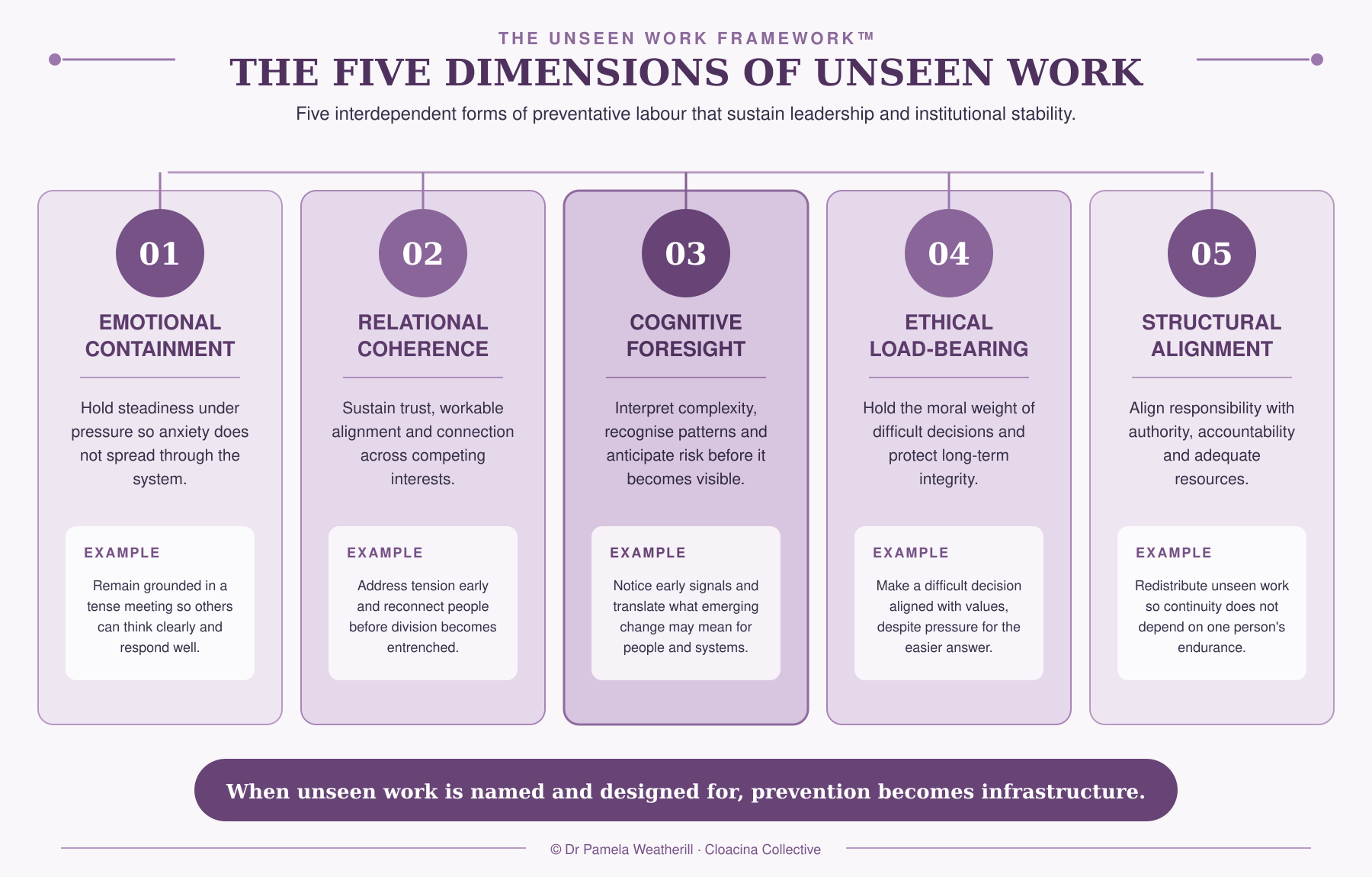
The framework identifies five interdependent dimensions of preventative leadership labour.
They are rarely clearly articulated.
They do not appear in formal job descriptions.
They are seldom designed for.
Yet seen performance depends upon their sustained operation.
Together, they form the hidden architecture of institutional stability.
Emotional Containment
The disciplined absorption and regulation of system-level anxiety.
This function prevents volatility from cascading across the organisation. It enables thinking under pressure and steadiness under scrutiny.
When unrecognised, it is mistaken for personality.
When concentrated, it becomes depletion.
When structurally supported, it becomes resilience.
Relational Coherence
The active preservation of trust and workable alignment across competing interests.
Relational coherence prevents fragmentation before division becomes seen. It repairs strain before it hardens into conflict and sustains collaboration across difference.
Without it, strategy fails at the human level.
Cognitive Foresight
The anticipatory integration of complexity and emerging risk.
Cognitive foresight operates ahead of formal metrics, holding multiple variables and future consequences in view. It prevents delayed recognition of threat and strategic blindness.
When dismissed, it is labelled caution.
When embedded, it becomes institutional intelligence.
Ethical Load-Bearing
The sustained holding of moral consequence over time.
This dimension guards against quiet erosion of standards and short-term decision-making that undermines long-term integrity. It involves acting in ambiguity and carrying responsibility where authority may be incomplete.
Without alignment, it isolates.
With alignment, it secures institutional credibility.
Structural Alignment
The calibration of responsibility, authority, accountability and resource.
Structural alignment prevents unseen labour from accumulating silently in one role. It ensures that the work required to sustain coherence is distributed rather than privately absorbed.
Where alignment is absent, risk concentrates.
Where alignment is present, continuity does not depend on endurance alone.
All five dimensions are preventative in nature. They operate before crisis. Before breakdown.
Before erosion becomes seen.
When they remain unseen, institutions rely on individual capacity.
When they are named and designed for, prevention becomes infrastructure.
Who This Framework Serves
The Unseen Work Framework™ is applied within:
· Boards
· Senior executive teams
· Founders
· Institutional leaders
· Complex organisations operating under sustained pressure
This is not personal development. It addresses structural responsibility in systems where consequence accumulates.
What Changes When Unseen Work Is Named
When unseen work is surfaced at structural level:
· Responsibility is redistributed rather than privately absorbed
· Governance accountability becomes clearer
· Risk concentration is reduced
· Authority and resourcing realign
· Institutional endurance strengthens
What was previously carried becomes governable.
Framework Architecture and Application
The Unseen Work Framework™ is used to:
· Diagnose unseen responsibility concentration
· Map preventative labour across roles
· Identify structural depletion risk
· Surface governance blind spots
· Redesign responsibility distribution
Application includes structured diagnostic processes, executive advisory engagement and institutional review.
The framework includes a formal diagnostic model and applied advisory process used within complex institutions.
Details are tailored to context.
For Boards and Executive Teams
Confidential diagnostic sessions are available to assess unseen responsibility concentration and preventative capacity within senior roles.
The Cloacina Collective™ exists to identify and diagnose unseen preventative labour, repositioning it as infrastructure rather than personality and embedding it within the architecture of responsibility and authority.
What changes when prevention is treated not as personality, but as infrastructure?
This framework sits within an ongoing program of inquiry expressed through advisory partnerships, leadership work, and commissioned writing.
Read more, including key essays and White Paper Series on Institutional Endurance.
© 2025 Pamela Weatherill.Please cite the original source when sharing or referencing this work.
Dr Pamela Weatherill is the founder of The Cloacina Collective and originator of the Unseen Work Framework™, a body of work examining maintenance, ethical authority and structural burnout in leadership and organisational life.