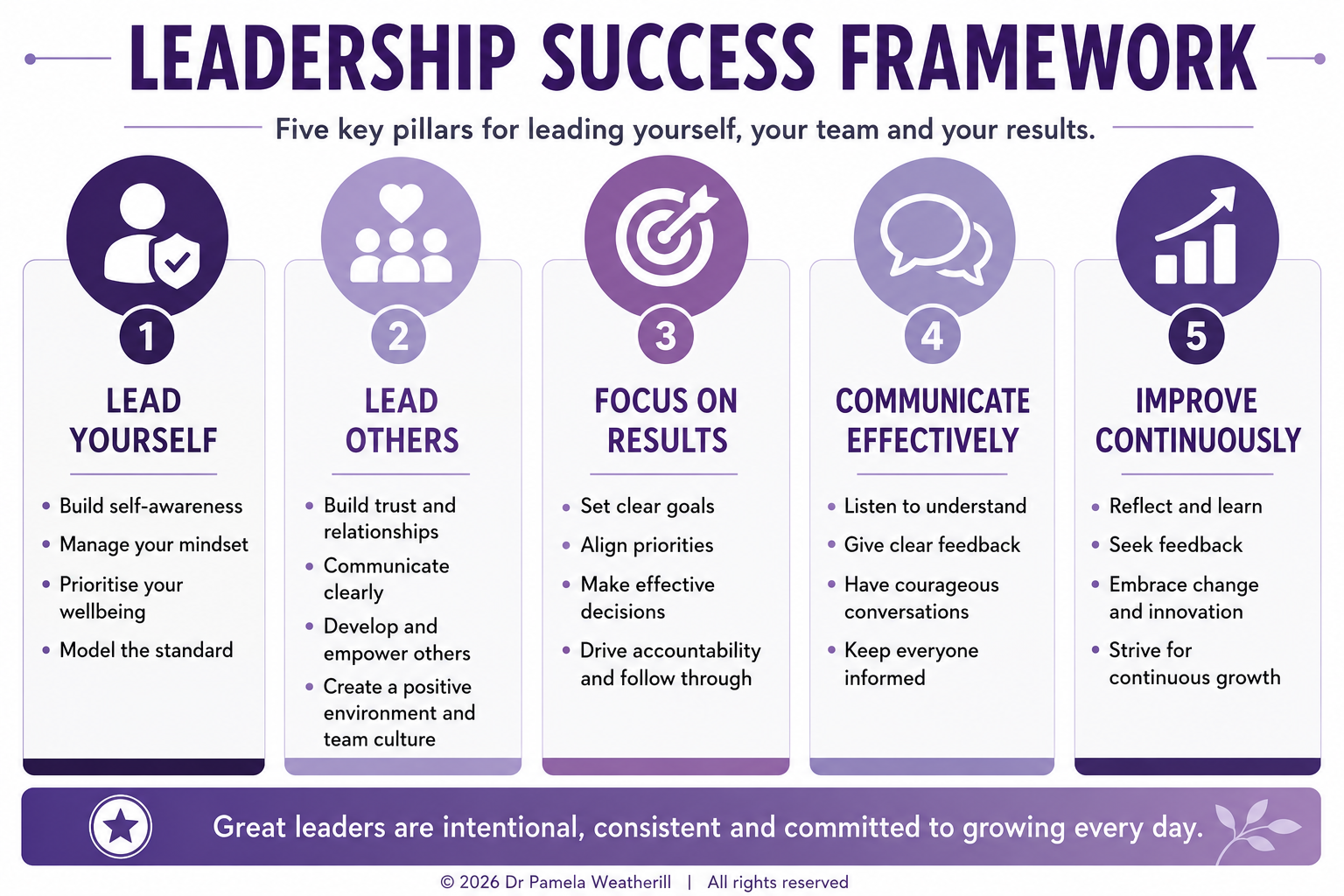
Leadership Success Framework™
Leadership is rarely strengthened through one skill alone. How a leader manages their own responses affects how they relate to others. Communication shapes accountability. The pursuit of results influences culture. Reflection determines whether experience becomes learning.
The Leadership Success Framework brings these connected responsibilities together through five pillars:
Lead Self · Lead Others · Communicate Effectively · Focus on Results · Improve Continuously
Developed by Dr Pamela Weatherill through senior leadership, human resources, organisational development and coaching practice, the framework provides a practical structure for understanding leadership capability. It helps leaders recognise where they are already effective, where pressure may be exposing gaps and where greater balance is needed.
No pillar stands alone. Leadership becomes more sustainable when all five are developed and held in relationship.
The Five Pillars of the Leadership Success Framework
Lead Self
Leadership begins with the capacity to understand and govern ourselves. Lead Self includes self-awareness, emotional regulation, personal responsibility, resilience and an understanding of how our values, habits and reactions affect others.
This does not mean suppressing emotion or presenting an image of perfect composure. It means noticing what is happening within us and choosing how we will respond. When leaders do not examine their inner state, fear, frustration and defensiveness can quietly enter their decisions and relationships.
Lead Others
Leading others means creating the conditions in which people can contribute, develop and take appropriate responsibility. It includes building trust, setting expectations, supporting growth, addressing performance and adapting leadership to the needs of different people and situations.
Care is an important leadership strength, but care can become rescue when leaders repeatedly carry what others need to learn to carry themselves. Effective leadership balances support with accountability, helping people grow in confidence and capability without creating unnecessary dependence.
Communicate Effectively
Communication is more than delivering information. It involves listening carefully, naming what matters, making expectations clear and creating space for honest dialogue. It also requires the courage to address concerns before silence allows them to deepen.
Leaders communicate through what they say, what they avoid and what they consistently reinforce. Clear communication helps people understand what is expected, why it matters and what needs to happen next. It also makes disagreement, feedback and accountability safer to navigate.
Focus on Results
Leadership carries responsibility for moving important work forward. Focus on Results includes setting direction, making decisions, establishing priorities, following through and ensuring that effort produces meaningful outcomes.
Results matter, but the way they are achieved matters too. A narrow focus on measurable outputs can overlook human cost, ethical concerns or the long-term strength of the system. Sustainable results require leaders to hold performance, purpose and consequence together.
Improve Continuously
Leadership development does not end when a program finishes or a particular skill has been mastered. Improve Continuously is the practice of reflecting, learning, adapting and making thoughtful changes over time.
Continuous improvement is not constant activity or change for its own sake. It includes recognising what is working, allowing useful practices to settle and learning from experience before moving forward. Reflection turns experience into insight and insight into more intentional leadership.
How the Framework Is Used
The Leadership Success Framework provides the practical foundation for Pamela’s individual coaching, emerging-leader development, executive coaching and organisational leadership programs.
It can be used to:
assess current leadership strengths and development needs;
establish meaningful coaching goals;
structure leadership programs and reflective conversations;
connect individual development with organisational expectations;
identify patterns affecting communication, accountability and performance;
evaluate changes in leadership confidence and practice.
The framework is not intended as a rigid sequence or leadership checklist. Different situations bring different pillars to the foreground. Its value lies in helping leaders see the connections between them and understand where an apparent strength may become less helpful when separated from the others.
Its Place Within The Unseen Work of Leadership
The Unseen Work of Leadership is the wider body of thought exploring the emotional, relational, ethical and structural forces operating beneath visible leadership and organisational life.
Within that body of work, the Unseen Work Framework identifies hidden organisational labour and strain. The Leadership Success Framework provides a practical capability model for developing leaders. The Just ONE THING Method supports deliberate action when responsibility and complexity become overwhelming.
The Leadership Success Framework also forms the practical foundation of Pamela’s current book project, The Unseen Work of Leadership: Why Leaders Still Need Legends.
The book brings the five pillars to life through fifteen original legends. Each pillar is explored through its gift, its shadow and its relationship with the other pillars. Readers first encounter the leadership tension through story, then consider what lies beneath it before carrying the lesson into their own leadership.
The legends reflect a central principle of the framework:
No leadership strength remains wise when it stands alone.
© 2026 Pamela Weatherill. Please cite the original source when sharing or referencing this work.
Dr Pamela Weatherill is the founder of The Cloacina Collective and originator of the Unseen Work Framework™, a body of work examining maintenance, ethical authority and structural burnout in leadership and organisational life.